
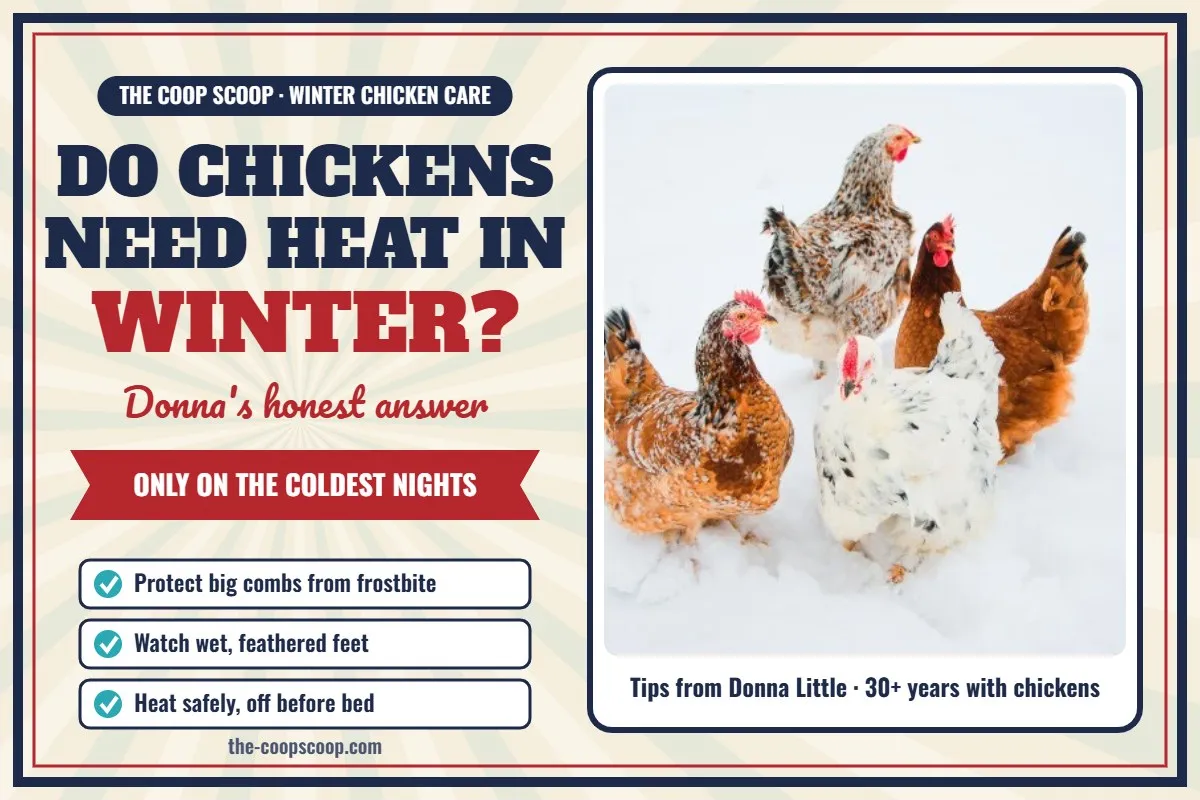
Do Chickens Need Heat in Winter? Donna's Honest Answer
Last updated November 2026
Do chickens need heat in winter? It depends on your breeds, your climate and your coop. Healthy chickens handle cold better than heat, but they can still suffer on extremely cold nights. Donna adds heat only on the handful of very cold nights each year (like a 15°F night) to protect big combs and feathered feet from frostbite, and she never leaves it running unattended overnight.
I'm Donna from The Coop Scoop, and I've raised chickens for more than 30 years. "To heat or not to heat" is one of the most heated questions in the chicken world, and with what looks like a hard winter ahead this year, it's on a lot of minds. Here's how I handle it in my own coop, and why I don't think there's one right answer for everyone.
Watch next: Donna's newest winter video, Do Chickens Need Heat In Winter?, covers moisture, drafts, bedding and wrapping the run: https://youtu.be/U8d2OGFBctc
Do chickens need heat in winter? Quick answers
Question | Short answer |
|---|---|
Do chickens need a heater? | Not usually. It depends on breed, climate and how draft-free your coop is. |
Which chickens struggle most in the cold? | Small or lightly feathered birds like Frizzle bantams, birds with big combs, and feather-footed breeds when their feet get wet. |
When does Donna add heat? | Only on the few extreme nights each year, like a forecast of 15°F. |
What heater does she use? | A small plug-in heater on its lowest setting, caged off, on a timer, and turned off before bed. |
No electricity? | Use the deep litter method, seal drafts and give them a sheltered roost. |
Why there's no single answer
Every flock is different. Your breeds, your climate and your coop all change the answer. Little Frizzle bantams in a drafty coop in Minnesota are a very different story from cold-hardy breeds in Florida, where summer heat is the bigger worry. Chickens do handle cold better than heat, and their body temperature runs around 105°F under all those feathers. That still doesn't mean they never struggle when it's extremely cold.
How cold is too cold for chickens? Watch combs and wet feet
I live in the Southeast, so we don't usually get a lot of severe cold. We get a handful of very cold nights sprinkled through the winter, and our weather can swing fast. One day it was 70°F, and four hours later it was 20°F. Two things make me reach for heat on those nights:
Big combs. Some of my girls have large, beautiful combs, and combs are the first place frostbite shows up.
Feathered feet that get wet. Almost half my flock has feathered legs and feet. Feathers seem like a bonus in the cold, but after sleet or a wet wintry mix, those feathers hold moisture. If it freezes on them, frostbite on the feet is a real risk.
Signs your chickens are too cold: huddling together against a wall, puffed-up feathers, necks pulled down, standing on one leg, or shivering.
Donna's advice: go with your gut
In chicken groups I see new keepers ask about a frigid night in an uninsulated coop and get shamed for wanting to help their birds. A few days later some of them are holding a rooster whose comb has turned black from frostbite. My priority is for my girls to be healthy, comfortable and safe, not just to survive the night. If your gut says it's too cold, take reasonable, safe steps to help them.
How Donna safely heats her coop on the coldest nights
The best-known option is a radiant panel like the Sweeter Heater, which hangs above the roost. They're not cheap, and chickens have to sit fairly close to benefit. I have 16 feet of roost bars, so I'd need about four of them. For a handful of nights a year, that wasn't cost-effective for me.
Here's what I do instead. I'm not telling you to copy it; it's just what I'm comfortable with:
A small plug-in heater (a Handy Heater) that plugs straight into the outlet, so there's no cord to trip over. The body stays cool enough to touch while it runs.
Blocked off and caged so no chicken can get near it, with a metal grate underneath.
On at about 5:00 PM, before they come in to roost around 5:45, on the lowest setting (60°F), with the heater's timer set plus a reminder on my phone.
Door cracked, not wide open, so there's less draft.
Off and unplugged around 10:45 to 11:00 PM. I don't leave anything electrical running all night, even when it feels cool to the touch.
This works for me because my coop is insulated. It used to be my workshop, so it holds heat. On our coldest night, my laser thermometer read 17°F outside and 43°F inside at about 11 PM. The temperature dropped slowly the rest of the night, and on the night it hit 15°F, the coop was still 36°F at 7:30 the next morning. Because it cools down gradually, they don't get a shock when I open the door.
Safety note: Any heat source in a coop is a fire risk. Use one only if you can block it off, keep it away from bedding and birds, and turn it off yourself.
The Handy Heater link above is an Amazon affiliate link. As an Amazon Associate I earn from qualifying purchases.
How to winterize a chicken coop without a heater
Deep litter method. Composting bedding makes its own warmth.
Seal drafts. Put plastic over windows, wrap a drafty coop and make sure doors close. No wide-open doggy door letting cold air blast in.
Hang blankets around the roost area so the flock can hold its body heat together.
Winter chicken heat FAQ
Do chickens need heat in the winter?
Usually not. Healthy, cold-hardy chickens in a dry, draft-free coop handle cold well. Consider extra help on extreme nights, especially for bantams, big-combed birds and feather-footed breeds.
How cold is too cold for chickens?
There isn't one number. It depends on breed, coop and moisture. Donna adds heat when nights drop to around 15°F, mainly to prevent frostbite on combs and wet, feathered feet.
What are signs my chickens are too cold?
Huddling together against a wall, puffed-up feathers, necks pulled down, standing on one leg, and shivering.
Is it safe to put a heater in a chicken coop?
Only with precautions. Donna uses a small heater plugged directly into the outlet, caged off, on a metal grate, on a timer at its lowest setting, and turned off before bed.
How do I keep chickens warm without electricity?
Try the deep litter method, seal drafts with plastic, close up the doors and hang blankets around the roost.
Get Donna's monthly Coop Scoop newsletter
Seasonal flock tips from our backyard, once a month. Sign up for the newsletter.
Related: How do you clean a chicken coop for winter? · Why did my chickens stop laying in fall? · Most docile chicken breeds for a mixed flock
About the author
Donna Little has raised backyard chickens for more than 30 years and shares her flock on The Coop Scoop YouTube channel. She's the author of Backyard Chickens Made Simple.